
An X-ray diffraction computed tomography study in Journal of Catalysis
determining failure mechanisms in industrial Cu/ZnO/Al2O3(−Cs2O) water–gas shift catalysts
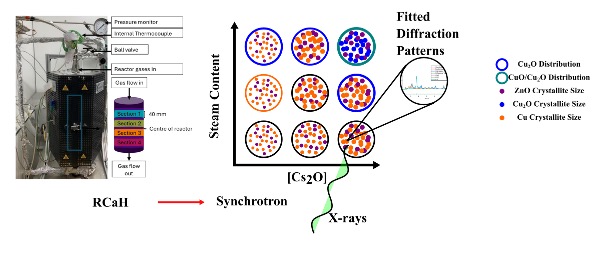
Dr. Sebastian Stockenhuber in collaboration with the UK Catalysis Hub has a paper published in the Journal of Catalysis. The water-gas shift (WGS) reaction is a key process for industrial hydrogen production used in ammonia synthesis, where Cu–Zn–Al (CZA) catalysts are typically employed. Since similar formulations are also used for methanol synthesis, 1 wt.% Cs2O is often added to mitigate its formation as an unwanted side product. However, this addition has recently been suggested to decrease the mechanical strength of the catalyst, particularly during initial reduction, leading to premature failure. This study investigated how gas composition (particularly water content) and pressure affect the structural and chemical evolution of recoveredCZA pellets after a typical reduction protocol, using pseudo-in situ X-ray Diffraction Computed Tomography (XRD-CT). As per Figure 1,they found that high water content (~20 vol.%) combined with increasing Cs₂O loading markedly promotes Cu⁰ crystallite growth, favours formation of Cu₂O, and enhances ZnO sintering. Although Cs might reduce methanol formation it clearly promotes water condensation and this leads to Cu⁰ crystallite growth which is particularly severe when in the form of Cu2O.1–3 These effects are most severe at the pellet periphery and ultimately compromise mechanical integrity. XRD-CT was useful in showing that Cu2O was prevalent on the pellet edges where we rationalised water could readily condense in the pores. The structural changes observed would negatively impact catalytic activity by virtue of: a) a loss of surface area of the sintered metallic Cu⁰; b) a lack of the metallic Cu⁰ active phase in preference to the oxide forms and c) a combination of a) and b) leading to complete mechanical failure of the pellet, inhibiting and ultimately stopping the gas flow and rendering the reactor unable to perform the reaction altogether. The results highlight the critical interplay between steam, pressure, and Cs promotion in governing catalyst stability during activation.
References
(1) Kowalik, P.; Próchniak, W.; Konkol, M.; Borowiecki, T. The quantitative description of the effects of cesium doping on the activity and properties of Cu/ZnO/Al2O3 catalyst in low-temperature water–gas shift. Applied Catalysis A: General 2012, 423-424, 15–20. DOI: 10.1016/j.apcata.2012.02.032.
(2) Kowalik, P.; Próchniak, W.; Borowiecki, T. The effect of alkali metals doping on properties of Cu/ZnO/Al2O3 catalyst for water gas shift. Catalysis Today 2011, 176, 144–148. DOI: 10.1016/j.cattod.2011.01.028.
(3) Behrens, M. Coprecipitation: An excellent tool for the synthesis of supported metal catalysts – From the understanding of the well known recipes to new materials. Catalysis Today 2015, 246, 46–54. DOI: 10.1016/j.cattod.2014.07.050.
Read the full article at https://doi.org/10.1016/j.jcat.2026.117088